

Style element exposed concrete.
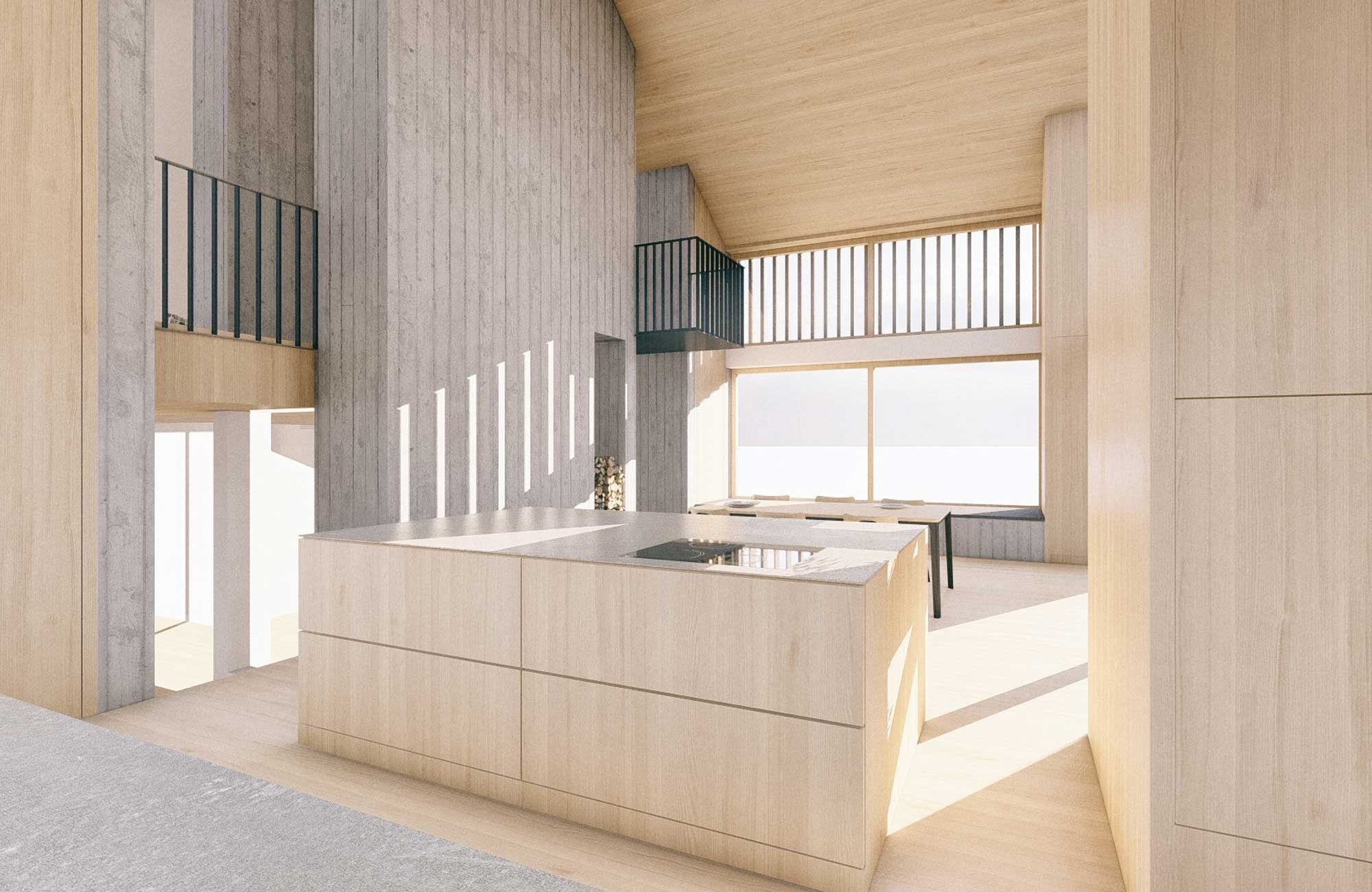
Sober exposed concrete with great effect.
Concrete has firmly established itself as a material not only in architecture and engineering, but also in interior design. With its purist simplicity, exposed concrete is an unmistakable element in modern house construction and is particularly impressive due to its versatility. We at SNOW Architektur are also enthusiastic about the variety of effects that exposed concrete can have.
In contemporary architecture, exposed concrete is a sought-after material that differs significantly in its appearance and production from normal concrete concealed behind wall cladding. Exposed concrete is designed from the outset to be neither plastered nor faced, but should deliberately remain visible as a mostly completely smooth concrete surface.
Despite this, there is still plenty of scope for design, allowing you to shape this concrete surface and adapt it to your own wishes. The special look is achieved either afterwards by treatment with grinding, milling, tapping or polishing equipment or from the outset by using specially textured formwork. The pattern is pressed into the fine exposed concrete and thus remains visible. There are also colored additives that can be added to the concrete mix. In this way, the exposed concrete is completely dyed in a desired color.
Despite the many possibilities that exposed concrete offers, it is still important to skillfully showcase it. Exposed concrete is particularly effective in spacious houses with high ceilings. Combined with an interior made of wood and other natural materials such as linen, flax, leather and fur, it creates a homely feel. Colors such as beige, ochre and brown as well as the natural green of plants set a counter-accent to the cool gray of the concrete and at the same time create a harmonious ambience.
In rooms with exposed concrete walls and ceilings, the furnishings should not appear overloaded. The purist nature of the unvarnished concrete suits a simple living style that dispenses with the superfluous and limits itself to a few soft color nuances. Light shades, including for the floor, provide more airiness and somewhat soften the heavy effect of the concrete material. The spaciousness of the rooms is created by large glass fronts that let in plenty of light. Individual color accents are accentuated much better by the neutral gray of the concrete, which looks like a stage set.
Concrete, the mixture of cement, gravel, sand and water, has long been a tried and tested building material. However, concrete also has significant ecological disadvantages. The production of cement in particular requires a lot of energy and causes high CO2 emissions. However, if you find a way to use fair-faced concrete wisely and at best give it a few functions, it makes perfect sense.
In our project (picture above), for example, the exposed concrete wall is not just a visually appealing room divider. Rather, the exposed concrete wall is assigned various functions, such as an opening for the fireplace visible on both sides and recessed wall shelves or temperature regulation.
Our project is characterized by the concrete core, which is encased in wood. In addition to its visual aesthetics, the concrete acts as a hybrid. Its particular advantage is its storage capacity, which we can make use of. With concrete core activation, the concrete wall can be used to store thermal energy and thus heat or cool rooms cost-effectively and innovatively. Prefabricated pipe systems are installed within the reinforcement layers. Water circulates in the pipes and, depending on the temperature, absorbs heat from the walls for a cooling effect or transfers it to the ceiling for heating.
In summary, it can be said that the considered use of exposed concrete, to which many functions are attributed, is entirely justifiable. From a design perspective, exposed concrete can be used in many different ways and lend rooms that certain something.